January 5, 2032 · 7:15 a.m. · The White House
President Susan Whitfield was already sitting at the conference table when the first person entered the room.
That was unusual. People normally waited for the President.
Whitfield had been awake since 4:40. On the table in front of her was a blue folder containing twelve pages of numbers she already knew. She had read them before going to bed. She had read them again before sunrise. Reading them a third time hadn't made them any better.
Maya Chen, the White House Chief of Staff, entered carrying coffee and a tablet.
“You're early.”
“So are you.”
“I'm paid to be.”
Whitfield looked at her. “So am I.”
Within minutes, the room began to fill.
Daniel Mercer, Secretary of the Treasury, took the chair immediately to Whitfield's right. At sixty-two, Mercer had spent most of his career moving between finance, academia and government. He had a reputation for answering complicated questions with numbers and simple questions with more numbers.
Dr. Lena Park, Chair of the Council of Economic Advisers, sat across from him. Park was an economist who had spent much of her academic career studying labor markets, taxation and income distribution.
Thomas Reed, the Chief Actuary of the Social Security Administration, opened a laptop but said nothing. He was the only person in the room who had been warning about this particular meeting for years.
Two congressional leaders joined them: Senator Robert Hale, the Senate Majority Leader, and House Speaker Patricia Monroe.
At 7:18, Whitfield looked toward the door. “Are we waiting for anyone?”
Chen shook her head.
Whitfield looked at Reed. “All right, Tom. Tell me how we got here.”
Reed connected his laptop to the screen on the wall. A graph appeared.
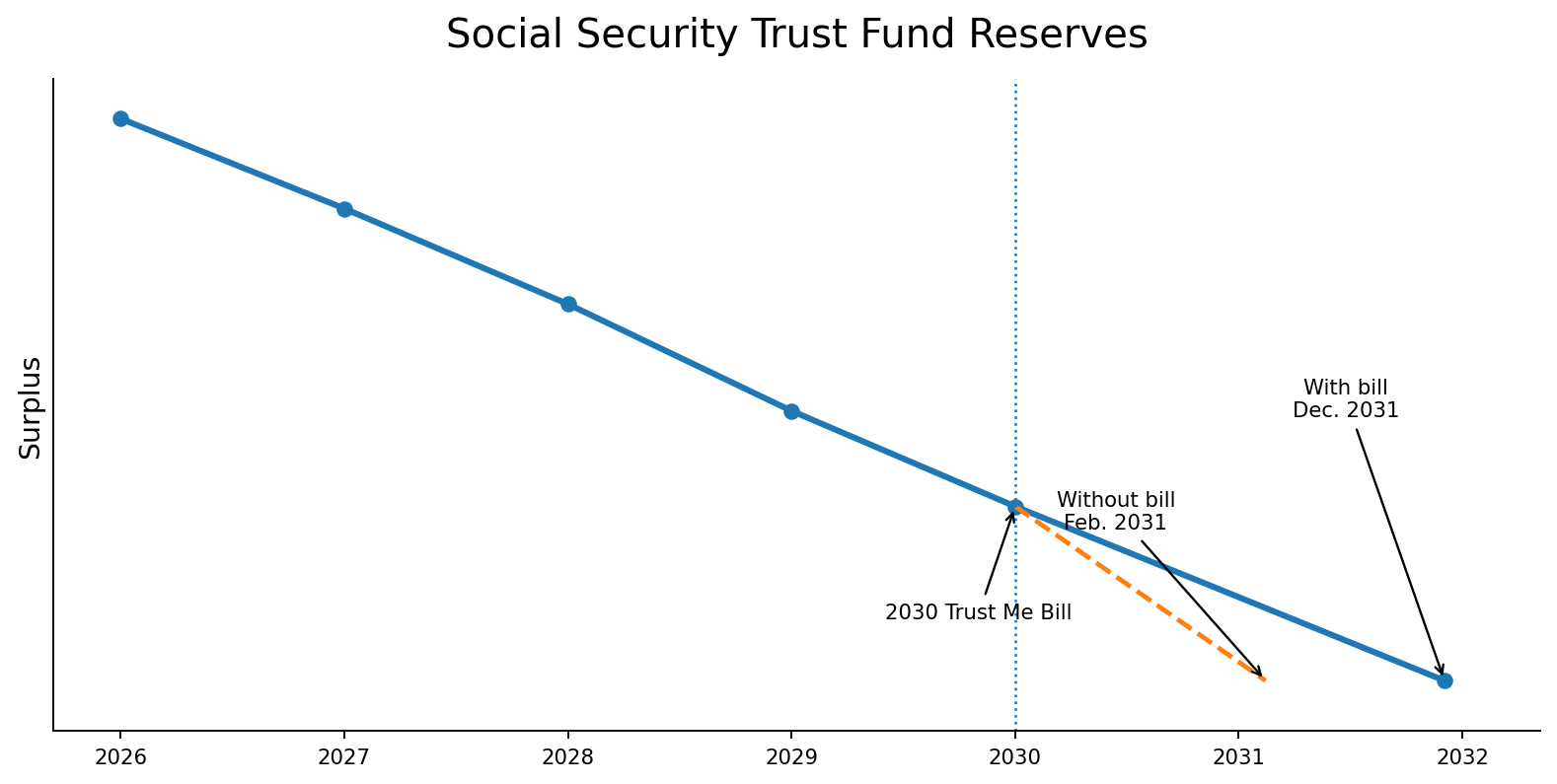
Whitfield stared at the line. “Every year, the reserves shrunk.”
Reed nodded. “And without the Trust Me Bill, they would have been gone last February.”
Monroe looked toward the screen. “Remind everyone what it bought us.”
“Ten months,” Reed said. “In our 2030 projection, the retirement trust fund would have exhausted its reserves in February 2031. The Trust Me Bill removed the taxable-wage ceiling for the Social Security portion of FICA. The 2030 ceiling was $225,000. After the law, there was no ceiling.”
Hale added, “Which meant higher earners began paying the Social Security tax on every dollar of wages, not just the first $225,000.”
“Correct,” Reed said. “That additional revenue pushed depletion from February to December. It delayed the day. It didn't solve the underlying imbalance.”
Monroe leaned forward. “And yet we told people we'd bought time to finish the job.”
Hale looked at her. “Congress didn't ignore it.”
“We passed one bill,” Monroe said. “Then acted as though ten months were ten years.”
Hale leaned back. “The White House signed it.”
Whitfield raised a hand. “We're not doing that.”
The room went quiet.
“I don't care whose fault it is. There will be plenty of time for that on television.”
She looked back at Reed. “What exactly happened December thirty-first?”
“Nothing happened to Social Security's ability to collect payroll taxes. Workers are still paying into the system. Employers are still paying into the system.”
“Then why can't we pay the benefits?”
“Because current income isn't enough. For years, the program used trust-fund reserves to make up the difference between incoming revenue and scheduled benefits. The reserves are now gone.”
Whitfield looked around the table. “So Social Security isn't broke.”
“No.”
“It still has income.”
“Yes.”
“But it doesn't have enough income to pay one hundred percent of scheduled retirement and survivor benefits.”
“Correct.”
“How much can it pay?”
“Approximately eighty-four percent.”
Nobody spoke for several seconds.
Whitfield finally broke the silence. “So let's say somebody was supposed to receive two thousand dollars.”
“Approximately sixteen hundred eighty.”
“Every month?”
“Yes.”
Monroe shook her head. “You can't do that.”
Mercer spoke for the first time. “We can restore the benefits. The question is how we pay for them.”
Hale folded his arms. “Raise the payroll tax.”
Mercer looked at him. “Again?”
“If that's what it takes.”
Park shook her head. “Two years ago we removed the taxable maximum. We already expanded the payroll-tax base dramatically at the top.”
Monroe looked at Hale. “So what are you proposing now? A higher rate on every worker and every employer?”
Hale didn't answer immediately. “I'm saying the benefits have to be paid.”
“Agreed,” Mercer said. “But the Trust Me Bill matters here. There is no wage cap left to raise. If payroll taxes are the answer, we're talking about increasing the rate.”
Park added, “Which means increasing the tax on employment at exactly the time we're trying to encourage wage growth.”
She paused. “And let's be clear about distribution. Payroll taxes fall on wages, not investment income. Relative to total income, that makes them regressive. Raising the rate makes that burden heavier on workers.”
Hale shook his head. “But after the Trust Me Bill, high earners pay the same Social Security rate on every dollar of wages. A rate increase would cost them more dollars too.”
“Of course,” Park said. “I'm talking about the share of total income, not the size of the check.”
Hale turned toward her. “We promised people these benefits.”
“And younger workers didn't make the promise.”
“They're going to retire someday too.”
“Which is precisely why the financing has to be sustainable.”
Monroe looked at Mercer. “Borrow it?”
Mercer almost smiled. “We're already borrowing.”
“So borrow more.”
“And add the interest to the bill we're handing the next generation?”
Hale shrugged. “Better than cutting my mother's Social Security check.”
Park looked at him. “And what about somebody else's daughter paying for it for the next forty years?”
Whitfield interrupted. “Good.”
Everyone looked at her.
“This is exactly the argument the country needs to have.”
Whitfield stood and walked toward the screen.
“We keep pretending there's a painless answer. Raise payroll taxes. Somebody pays. Reduce benefits. Somebody pays. Borrow it. Somebody eventually pays. Raise the retirement age. Somebody works longer.”
She turned around. “There is no box on this chart marked free.”
Whitfield returned to her chair. “There is one other base.”
Mercer looked at her. “You're bringing it back.”
Hale sighed. “Here we go.”
Whitfield smiled slightly. “You all survived the campaign.”
They knew exactly what she meant.
Four years earlier, candidate Susan Whitfield had made one of the more controversial arguments of the 2028 campaign: too much of the American economy escaped the taxes that supported Social Security. She pointed first to the underground economy — cash jobs, unreported services, off-the-books businesses and illegal activity — but she went further. Corporate and individual tax deductions reduced taxable income. Investment income could flow through trusts, foundations and endowments. Religious organizations and other tax-favored entities occupied still other parts of the tax code. To Whitfield, the larger question was whether the country had built a system that taxed ordinary wages very efficiently while allowing too much other economic activity to contribute little or nothing toward Social Security.
Her policy team had pushed back on the shorthand. Corporate profits were not wages. Dividends, capital gains and most trust income were not wages either. Tax-exempt foundations generally still paid payroll taxes on employee wages, as did most religious organizations. Deductions served purposes Congress had deliberately chosen to encourage. Each category was different, and none by itself was a simple substitute for payroll taxes.
Whitfield understood the distinctions. But she kept returning to the same political point: the worker whose taxes came out of every paycheck could see an enormous amount of money moving through the American economy that did not contribute to Social Security in the same way.
She knew she had hit a nerve when polling in Georgia and North Carolina moved sharply in her direction. That gave her the confidence to make it part of her platform, which she announced at a campaign stop in Raleigh, North Carolina.
“If you get up every morning and go to work, Washington takes Social Security taxes out of your paycheck before you ever see it. But there are billions of dollars moving through this economy that never contribute a dime. That's not fair. If you participate in the American economy, you should pay your fair share toward the cost of America.”
Opponents attacked the proposal as the beginning of a national sales tax. Whitfield insisted she was not proposing a finished tax plan. She was asking whether a broader tax base could reach economic activity that escaped the income- and payroll-tax systems.
Now, with reelection nine months away, the idea had begun appearing again in Whitfield's private political discussions. This morning she was testing it on the people most likely to tell her why it was a bad idea.
“We keep talking about wages,” Whitfield said.
Mercer nodded. “Because Social Security is financed primarily through payroll taxes.”
“And two years ago we removed the wage ceiling. We did the obvious thing. It bought ten months.”
She looked around the table. “But wages still aren't the whole economy.”
Park leaned back. “You're talking about consumption.”
“I'm talking about whether people who successfully avoid income and payroll taxes can avoid contributing when they spend the money too.”
Hale frowned. “A national sales tax.”
“We've had this argument before, Robert. That's one design. It isn't the only design.”
Monroe said, “And you're thinking about putting this back into the reelection campaign.”
Whitfield didn't answer directly. “I'm thinking about whether it solves a real problem.”
Mercer understood. “And you want to know whether it can help close the Social Security gap.”
“Among other things.”
Whitfield looked at him. “Run one percent.”
Mercer nodded this time. “Broad base?”
“Broadest reasonable base. Then start showing me the tradeoffs.”
Park shook her head. “A consumption tax is regressive.”
Whitfield nodded. “Then when we model it, don't show it to me in isolation. Show me what happens to workers under the whole system. We'll come back to payroll taxes later.”
Whitfield looked at her. “I know.”
“Lower-income households consume a greater percentage of their income.”
“I know that too.”
Whitfield held up her hand. “That's not a reason not to run the numbers.”
“If it hurts a family making sixty-five thousand dollars more than a family making six hundred fifty thousand dollars, show me. Then fix it.”
Mercer leaned forward. “Exempt necessities?”
“Maybe.”
“Food?”
“Maybe.”
“Medicine?”
“Maybe.”
“A rebate?”
“Maybe.”
Hale interrupted. “And every exemption shrinks the base.”
Whitfield pointed at him. “Exactly. So show me that too.”
“I want one percent with the broadest reasonable base. Then show me what happens if we exempt necessities. Then show me a rebate. Then show me combinations.”
Park said, “And distribution by income.”
“Absolutely.”
“Inflation impact.”
“Yes.”
“Effect on consumption.”
“Yes.”
“Compliance costs.”
“Yes.”
Monroe added, “Political survivability.”
Whitfield looked at her. “You can handle that one.”
Monroe smiled. “Finally, something easy.”
Then Mercer asked, “What exactly are you trying to accomplish?”
Whitfield looked at him. “Restore the Social Security benefits.”
“Only that?”
Whitfield paused. “For now.”
Mercer noticed. So did Park. Chen definitely noticed.
Hale leaned forward. “What does that mean?”
“It means we're solving the problem in front of us.”
Whitfield closed the blue folder. “Forty-eight hours.”
“Madam President—”
“Daniel.”
“Yes?”
“Don't bring me a presentation explaining why it can't work. Bring me the numbers.”
Then she headed for the door.
Monroe called after her. “And when the press asks what we're doing?”
Whitfield stopped. “Tell them we're working.”
Monroe smiled. “They're going to love that.”
Whitfield opened the door. “They never do.”
And she was gone.